Why Do Airplanes Leave White Lines Across the Sky?
The white lines behind high-flying aircraft may look like smoke, but most are actually clouds formed when hot engine exhaust meets extremely cold air.
Burning jet fuel releases water vapor along with carbon dioxide and tiny particles. At cruising altitude, temperatures can fall below minus forty degrees Celsius. When the warm, moist exhaust mixes with this frigid air, the water vapor freezes around particles into tiny ice crystals, creating a condensation trail, or contrail.
How long a contrail lasts depends largely on humidity. In dry air, the ice crystals quickly turn back into invisible water vapor, and the trail disappears within seconds or minutes.
In cold, moist air, however, the crystals can persist and grow. Winds may spread the trail sideways until it resembles a cirrus cloud, and several trails can merge into a thin sheet across the sky.
Contrails can also begin and stop abruptly while an aircraft continues flying normally. This happens when it passes through invisible regions with different temperature and humidity, revealing boundaries in the upper atmosphere.
Brief clouds can also form around airplane wings during takeoff or landing because pressure changes cool moist air, but these have a different immediate cause.
So the long white line behind a cruising airplane is not something stored inside the aircraft. It is a temporary cloud created when engine exhaust encounters air cold and moist enough to support ice.
Source: Aircraft Contrails, United States Environmental Protection Agency - Contrails, National Weather Service
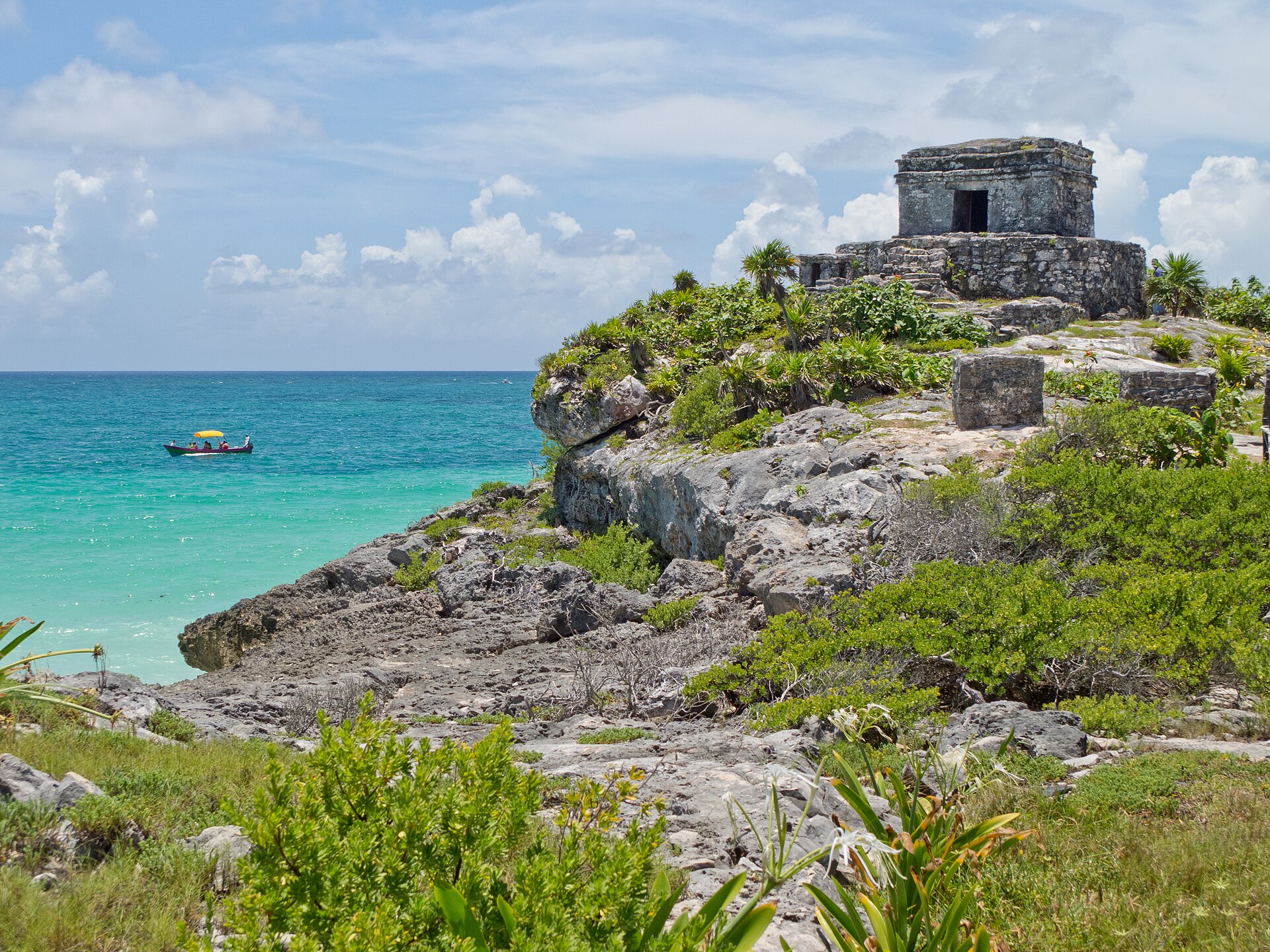
Temple of the Wind God (Templo del Dios Viento), Tulum, Mexico
Source: By Carlos Delgado